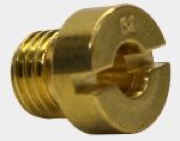
A twin with two carburettors only runs smoothly when both slides are open by the same amount. If one cylinder is ahead of the other, the engine shakes at idle, picks up unevenly and runs rough on the overrun. Balancing, or synchronising, means setting both carburettors so they do the same thing at idle and when you open the throttle.
The steps below follow the workshop manual of the Moto Guzzi 850 Le Mans II with two Dell'Orto PHF 36. The manual describes two methods: one without instruments and one with a vacuum gauge. Other Guzzi twins with Dell'Orto work the same way; the figures for your model are in your manual.
Signs your carburettors are out of balance
- The engine shakes noticeably more than usual at idle.
- Idle speed hunts or drops when you pull the clutch.
- It snatches when you open the throttle gently, although the jetting is right.
- The two plugs look different.
Before balancing, the rest must be right: ignition, valve clearance, no air leaks at the inlet rubbers and the correct jetting on both sides. Balancing only matches the two sides. It doesn't fix a fault on one cylinder.
Preparation: cable free play
The manual starts with the cables, because the wrong free play spoils every setting:
- Choke cable: lever in the run position. There should be about 3 mm of play between cable outer and adjuster on both carburettors.
- Throttle cable: grip closed. Both cables should have 1 to 1.5 mm of play at the handlebar end. If not, loosen the locknut, turn the adjuster and lock it again.
Then ride the bike until it is fully warm. Balancing is only done at operating temperature.
A tip from the Guzzi forums for both methods: only turn the throttle stop screws while holding the throttle open a tiny bit. When the slide rests on the screw tip, its spring presses it down hard, and turning the screw can damage screw and slide.
Without instruments: exhaust pressure and cutting a cylinder
You need both hands for this, ideally with a helper.
- Gently screw both mixture screws all the way in, then back them out 1.5 turns. That is the figure the manual gives for the Le Mans II with PHF 36.
- With the engine running, hold one hand at each exhaust outlet. The pressure should feel the same on both sides. If not, adjust the throttle stop screw on one carburettor: screw it in on the cylinder with less pressure or out on the cylinder with more. Keep the idle at about 1000 to 1100 rpm.
- Use the mixture screw on each cylinder to find the point where the engine revs highest. Then reset the idle speed.
- Pull one plug lead at a time. The engine should die after the same number of firings both times. If it keeps running longer on one cylinder, back out that carburettor's stop screw a little or screw the other one in.
- Set the idle to 1000 to 1100 rpm by turning both stop screws by the same amount.
- Now check the opening: your helper opens the throttle slowly while you feel whether the pressure rises at both outlets at the same time. If one cylinder comes in earlier, adjust the cable adjuster on that side until both match.
To be honest: many experienced Guzzi owners consider this method crude. It will do on the road or as a first setting. For a really smooth engine you need a gauge.
With a vacuum gauge
The manual describes a vacuum gauge with two mercury columns. Today most people use a carb balancer with dials, liquid columns or a digital display. The principle is the same: you compare the vacuum in both inlet stubs.
Dial gauges without damping flicker with every intake stroke at idle. Many Guzzi owners therefore prefer liquid columns or an electronic balancer. Whatever you use, read the average, not the peaks. Check first that both gauges read the same: connect them to the same port with a Y-piece.
- Check the cable play as above.
- Screw the mixture screws all the way in and back out 1.5 turns. Backing out makes the mixture richer, screwing in makes it leaner.
- Remove the blanking screws on the inlet stubs and connect the gauge hoses.
- Engine warm, idle at 1000 to 1100 rpm. Use the throttle stop screws to make both readings equal. The closer the readings get, the more the idle usually rises. Turn it back down as you go.
- Find the highest idle with the mixture screws, then check the readings again. Repeat the previous step if needed. Guzzi forum regulars recommend backing the mixture screw out another quarter to half turn afterwards, so the idle is slightly rich.
- Open the throttle slowly and watch the readings. If one side drops earlier as you open, its cable is pulling first. Adjust the throttle cables at the handlebar until both drop together and stay level.
- Remove the hoses and refit the blanking screws with their sealing washers. An open hole in the inlet stub is an air leak.
The moment of opening is what matters. Experienced Guzzi owners say balance just off idle, when you pull away at the lights, is what counts. At large throttle openings and high revs the engine hardly notices small differences. If the bike snatches as you pull away, this transition is often out of balance.
Which method should you use?
| Without instruments | With vacuum gauge | |
|---|---|---|
| Tools | rev counter, screwdriver, a helper | carb balancer for two cylinders |
| Accuracy | rough, more of a stopgap | more precise, especially off idle |
| When it makes sense | on the road when you have no balancer with you | after carburettor work, with persistent shaking |
A carb balancer is worth having if you look after your own bike. It connects quickly, and you see straight away whether something has moved.
Common pitfalls
- An air leak at one inlet stub falsifies the reading. Seal it first, then measure. To find leaks, spray a little brake cleaner around the inlet stubs with the engine running: if the revs change, it is drawing air there. Never spray onto the hot exhaust or the ignition.
- If one side always reads differently, swap the hoses as well as the gauges. A cracked or soft hose falsifies the reading.
- A worn slide or body can't be balanced cleanly.
- Different jetting left and right is not a fault if the factory specified it. The Ducati 600 Pantah, for example, has a different main jet on each side. Check in the jetting database.
- Always rebalance after cleaning or overhauling the carburettors. How to overhaul them is in Cleaning and overhauling a Dell'Orto.
Where this information comes from
Figures and procedures are from the Moto Guzzi 850 Le Mans II workshop manual, carburettor chapter. We checked the practical tips against reports from experienced owners: on thisoldtractor.com (Guzzi technical archive) and on Motor-Talk.
Still not running smoothly?
Then it is often the jetting or worn parts. The figures for your model and the matching parts are in the jetting database. Happy to answer questions.