You tune a Dell'Orto from the top down. Main jet for full throttle first, then needle and needle jet for part throttle, and idle jet and mixture screw last. If you start with the idle, you will only have to reset it later. This guide covers what to check beforehand, where your starting values come from and how to tell whether each step is right.
Before you touch the jets
Jetting can only be right if the rest of the engine is. Otherwise you end up compensating with jets for faults that have nothing to do with the carburettor. Check these first:
- Ignition: plugs, caps and timing to the workshop manual, and the points gap on points ignition.
- Valve clearance to the workshop manual.
- Air leaks: inlet rubbers and flanges sealed, no cracks. An air leak causes exactly the symptoms people usually blame on the jetting.
- A clean carburettor: the idle jet and the fine passages are the first to clog after a long lay-up.
- Float level to the factory figure. Every jet size depends on it.
Only test with a warm engine, and change exactly one thing per test ride. With two changes at once you won't know which one made the difference.
Your starting point is the factory jetting
Always work from the factory jetting. But first write down what is actually fitted. Many carburettors have been re-jetted over the years, and previous owners rarely kept notes.
The Moto Guzzi Le Mans III shows how closely you need to look. For 1981 the factory table lists three versions of the PHF 36, told apart by a coloured dot on the carburettor, plus a separate US version:
| Version | Main jet | Idle jet | Needle (notch) | Needle jet |
|---|---|---|---|---|
| no dot | 132 | 60 | K 5 (2) | 265 AB |
| red dot | 115 | 50 | K 18 (3) | 265 AB |
| green dot | 115 | 50 | K 18 (3) | 268 AB |
| USA (PHF 36 DS/DD) | 120 | 50 | K 27 (2) | 262 AB1 |
There are a lot of jet sizes between 115 and 132. Take the wrong line and you start a long way off. So look at your carburettor before you copy a value.
Step 1: full throttle and the main jet
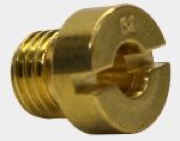
The main jet controls the mixture from about half throttle to full. Judge it at full throttle in the mid and upper rev range on an open road. Then pull the clutch, switch off, coast to a stop and look at the plug. How to read it is explained in Reading spark plugs.
- Too lean: the engine pulls weakly at the top, runs hot, the plug is pale to greyish white. Go one size bigger.
- Too rich: the engine burbles and runs rough, the plug is sooty. Go one size smaller.
If in doubt, start one size too big and work down. A lean mixture at full throttle is the most dangerous state for the engine.
Step 2: part throttle with needle and needle jet
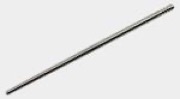
Between about 1/8 and 3/4 throttle the needle and needle jet set the mixture. That is where you ride most of the time. Your first tool is the notch the needle clip sits in:
- Clip one notch lower: the needle sits higher and the mixture gets richer.
- Clip one notch higher: the needle sits lower and the mixture gets leaner.
If the engine snatches at a steady speed or stumbles when you open the throttle gently, part throttle is probably lean. If it feels lazy and burbles, it is probably rich. If the notches don't give you enough adjustment, try a different needle jet. A different needle profile changes the whole curve and is the last step, not the first.
Step 3: idle and the mixture screw
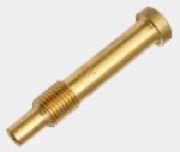
Finally the range from idle to about 1/4 throttle. The Moto Guzzi workshop manuals from the carburettor era give 1.5 turns out as the basic setting of the mixture screw. From there, turn slowly until the engine runs highest and smoothest, then reset the idle speed.
- If the engine only runs cleanly on the choke or pops on the overrun, the idle is lean. Often a passage is simply blocked.
- If it only runs cleanly with the screw well over two turns out, the idle jet is probably too small. If the screw is almost closed, it is probably too big.
Two carburettors are not always jetted the same
On twins, many people assume left and right are identical. That isn't always so. According to the Dell'Orto catalogue the Ducati 600 Pantah has a 138 main jet on the left and a 132 on the right. On the 1981 Hesketh V1000 it is 155 left and 150 right. Always check both sides in the factory data.
Once the jetting is right, balance the carburettors. A V-twin with slides opening unevenly can't be judged properly.
If it still won't come right
If you can't get a consistent result despite working in the right order, the fault is usually elsewhere: an air leak, ignition, float level, or worn slides and needle jets. On heavily modified engines a lambda reading or a dyno session tells you more in a short time than many weekends of plug reading. The tuning guide on every carburettor page also lists which part belongs to which symptom.
Which parts do I need for my carburettor?
Every model page in the jetting database lists the matching jets right next to the figures. If something is missing or you're not sure, send us your model and carburettor type.